Politics from the Cheap Seats
Rebuilding the Middle Ground of American Democracy
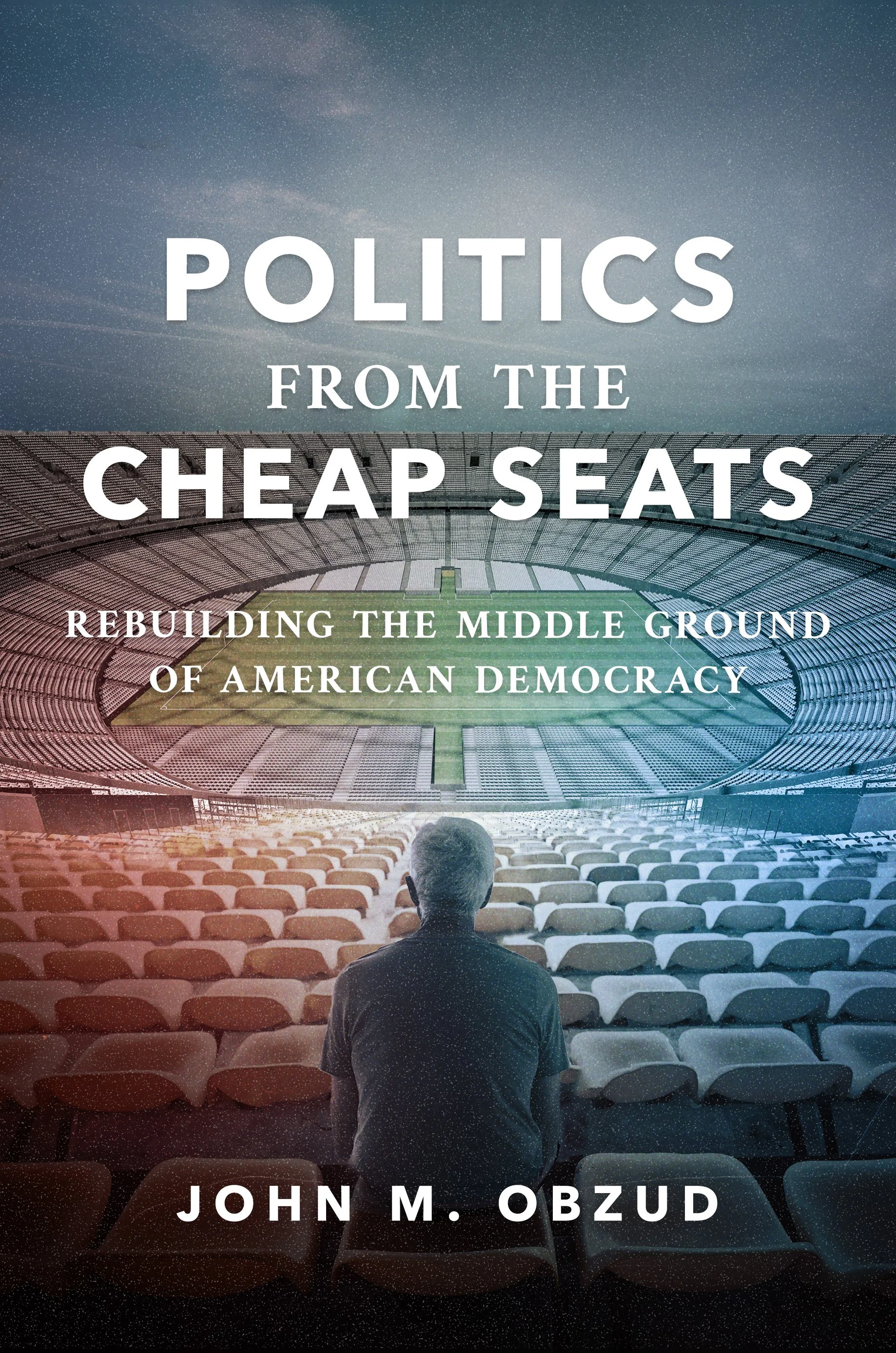
Politics from the Cheap Seats is a non-partisan, reflective examination of how American democracy drifted from shared civic expectations toward constant political noise—and how it can find its way back to the middle ground.
Written from the perspective of a lifelong “cheap seats” observer, the book blends personal experience, public service, private-sector accountability, and long-view reflection across more than six decades of American political life. Rather than arguing ideology or party, it argues for perspective—the kind earned by watching institutions work, fail, recover, and endure over time.
Pre-Order Now
Advance praise for Politics from the Cheap Seats

"As a Democratic mayor, I've often said that there is no Democratic way to pave a road and no Republican way to pick up the garbage. Local government has a way of reminding us that citizens expect results more than rhetoric, and that is one of the great strengths of John Obzud's Politics from the Cheap Seats.
Drawing on his own experience in local government, John makes a compelling case that too much of our national politics has become consumed by performance rather than problem-solving. I appreciate his willingness to challenge readers to think beyond partisan talking points. His call for greater accountability, practical leadership, and renewed civic engagement deserves to be part of our national conversation. Americans across the political spectrum will recognize many of the frustrations he describes because they see them reflected in their own communities.
This book is a thoughtful reminder that democracy works best when we spend less time trying to defeat one another and more time solving the problems our neighbors actually face. Whether you're a Republican, Democrat, Independent, or simply someone who believes our politics can work better, Politics from the Cheap Seats offers an engaging and worthwhile perspective on rebuilding trust in American democracy."
Bryan Kennedy, Ph.D.
Mayor, City of Glendale Wisconsin
President, Democratic Municipal Officials
Member, Democratic National Committee
Author, "It's All Local: Saving Democracy From the Ground Up"
Founder/President, It's All Local Foundation
“Politics from the Cheap Seats cleverly puts the reader in the stands as a centrist, reminding us that politics doesn’t have to be about noisy partisan practitioners and extremist warriors. Instead, as the book claims, politics is about us—the people in the center of today’s ideological battles—the ones most affected by political and policy outcomes. Best of all, author Obzud does it in plain, every person’s language that readers can easily understand. He concludes with a call for a new middle ground and a workable plan for America’s future. A must-read for those who are sick and tired of the hateful tone that dominates our nation’s dialogue.”
David Randal
Author, Kelsey’s Crossing
“This book is a great start to get people thinking about ways to get America back on the right track. It will take a concerted effort by the Center-Left, Center-Right and Independents to overcome the excessively loud noise and influence by the radical fringes on both sides. America has a chance, but it will take modern patriots to pick up the fight started by the Founding Fathers.”
Philip Brill, LCDR (Ret.)
“Politics from the Cheap Seats, by John Obzud is a fascinating read. It is a refreshing take on our current political and civic situation. He moves beyond the shouting and chaos that poses as informed commentary and really digs into the causes and consequences of the decline of our nation’s body politic. He does not blame any one side. Instead he reviews how we got here and, more importantly, provides excellent solutions, solutions that require all sides to participate in. The book is highly readable and a valuable contribution to our current political debate.”
Richard L. Spees
Of Counsel, Akerman LLP
“John Obzud’s dream is that it is time for Americans to step back from the ledge of extremism and recover an ethic of civic participation and common sense. Politics from the Cheap Seats suggest how we can get there. Anyone who cares about the nation’s future should read it carefully.”
John Bodnar
Distinguished Professor Emeritus, History, Indiana University
“An eye-opening alternative to the current noise and chaos, Politics from the Cheap Seats, reminded me of reading Malcolm Gladwell’s Tipping Point—guiding us to reevaluate what we already know in a new way. Obzud provided a well-thought through framework for bringing America back together, preserving Democracy, and moving us forward into a better future.”
Jan Alpert
Retired and non-profit volunteer after a thirty-five year career in the title insurance industry
“The Middle Ground is not gone. We are just waiting in the Cheap Seats for the two fighters to tire themselves out. John Obzud offers some common sense and a playbook for how the middle can be restored.”
John F. Connolly
Aerospace Engineering Professor, NASA (Ret.)
“Part memoir, part observer analysis formulated from various “cheap seats” across his experiences in both the public and private sectors, Mr. Obzud captures the major turning points of American political culture over the last seven decades. In an effort to build an understanding of how we got where we are today, this book touches on an impressive range of topics—from media to religion, education to the global world order, and money in politics to an erosion of trust and investment in institutions—making it an ideal read for those who want to get up to speed quickly on these important turning points in short, easily digestible chapters. And for those also grappling with how we get back to a place where elected officials are accountable to constituents and constituents are actively contributing to their own communities, this book invites you to consider the “Middle Ground” as part of the solution.”
Dr. Caroline L. Payne, Ph.D.
Associate Professor & Chair, Department of Political Science Lycoming College
“John Obzud’s ‘Politics from the Cheap Seats: Rebuilding the Middle Ground of American Democracy’ is a powerful, timely blueprint for healing our political division and strengthening our democracy. The author challenges us to look beyond partisanship and remember the shared values that truly unite us. A vital, common sense roadmap for our future. The average life span of a democracy is 225 years, we are at the crossroads, this author’s insightful approach gives hope for the future.”
James Brothwell
Colonel, United States Marine Corps Reserve, Retired
“I recently read Politics from the Cheap Seats: Rebuilding the Middle Ground of American Democracy by John Obzud and really enjoyed it. John looks at politics through the eyes of an everyday American—not a politician, Washington insider, or ranting TV news or social media personality. His writing is clever, honest, opinionated, and very easy to read. He writes about the issues, personalities, frustrations, and sometimes the absurdity of today’s political world in a way that feels familiar, like you’re sitting around talking politics with a friend.
I do not consider myself a political person, but John’s insights and opinions line up with many of my own observations, concerns, ideas, and hopes. I found his discussion of political accountability for action and inertia, along with his concept of the “Middle America Contract,” based on fairness, honesty, and balance, particularly astute. The author’s analogy of organizational function as a “three-legged stool,” with the legs representing trust, leadership, and civic responsibility, is a visual that will remain with me. As an educator, I also appreciate the chapter-concluding “Cheap Seats Observations” summaries. They are an excellent way to refocus the reader’s attention on the most important points of each discussion.
If you enjoy talking politics, questioning what’s going on, and maybe having a laugh about some of the craziness along the way, this is definitely worth a read. John may be writing from the cheap seats, but he proves you can often see the game a whole lot clearer from up there.”
Stephen J. Voyce, MD
Professor of Cardiology, Geisinger Commonwealth School of Medicine
“…I kept waiting for a partisan angle or an insult about one political affiliation or other. Instead - it is a read that will make you explore what you agree or disagree with & what direction you wish to see the US heading. It is your country too, but legislators & government officials tend to skip over that (unless they need you at the polls or they want a contribution).
How much did I enjoy the book? The holidays are coming in a few months & I enjoy giving books that I had the honor of reading as an advance reader. I just ordered two so buying books even after you read them is a true endorsement.”
Edie M.
NetGalley Review
The early sections ground the reader in small-town America, where accountability was personal and civic responsibility was assumed rather than debated. From there, the narrative follows successive twenty-year life cycles through social upheaval, public service, and professional life, showing how lived experience shaped a grounded, middle-of-the-field view of politics and democratic responsibility.
At its core, the book examines how modern politics became dominated by noise—bureaucracy, money, media, social platforms, algorithms, and performative outrage—often crowding out deliberation, trust, and leadership. Instead of assigning partisan blame, the book focuses on consequences: civic exhaustion, institutional strain, and the erosion of the middle ground that once stabilized democratic life.
The book’s central framework, the Middle America Contract (MAC), reframes civic expectations around three essential pillars—Trust, Leadership, and Civic Responsibility. The argument is practical rather than ideological: democracy functions best when shared standards of conduct matter more than winning arguments.
The final section, The End Game Never Ends, steps away from debate and into reflection. Taking the long view from the Cheap Seats, it synthesizes decades of observation, places today’s turbulence in historical and human context, and looks forward to the responsibility of preparing the next generation to inherit and sustain democratic institutions.
Politics from the Cheap Seats is written for readers who are tired of partisan combat, skeptical of absolutism, and searching for a constructive middle ground. It will resonate with independents, moderates, civic-minded conservatives and liberals, and anyone who believes democracy works best when judgment tempers passion and responsibility outlasts victory.
This is not a call to disengage.
It is a call to think.
And to care enough about the game to preserve it.
The Cheap Seats
Observations Blog