Philadelphia: Where Ordinary Citizens Made Extraordinary History
A Personal Independence Day Reflection from the Birthplace of America
As America approaches its 250th birthday, I recently found myself walking the streets of Philadelphia, the birthplace of our nation and the setting for one of history’s most remarkable experiments in self-government.
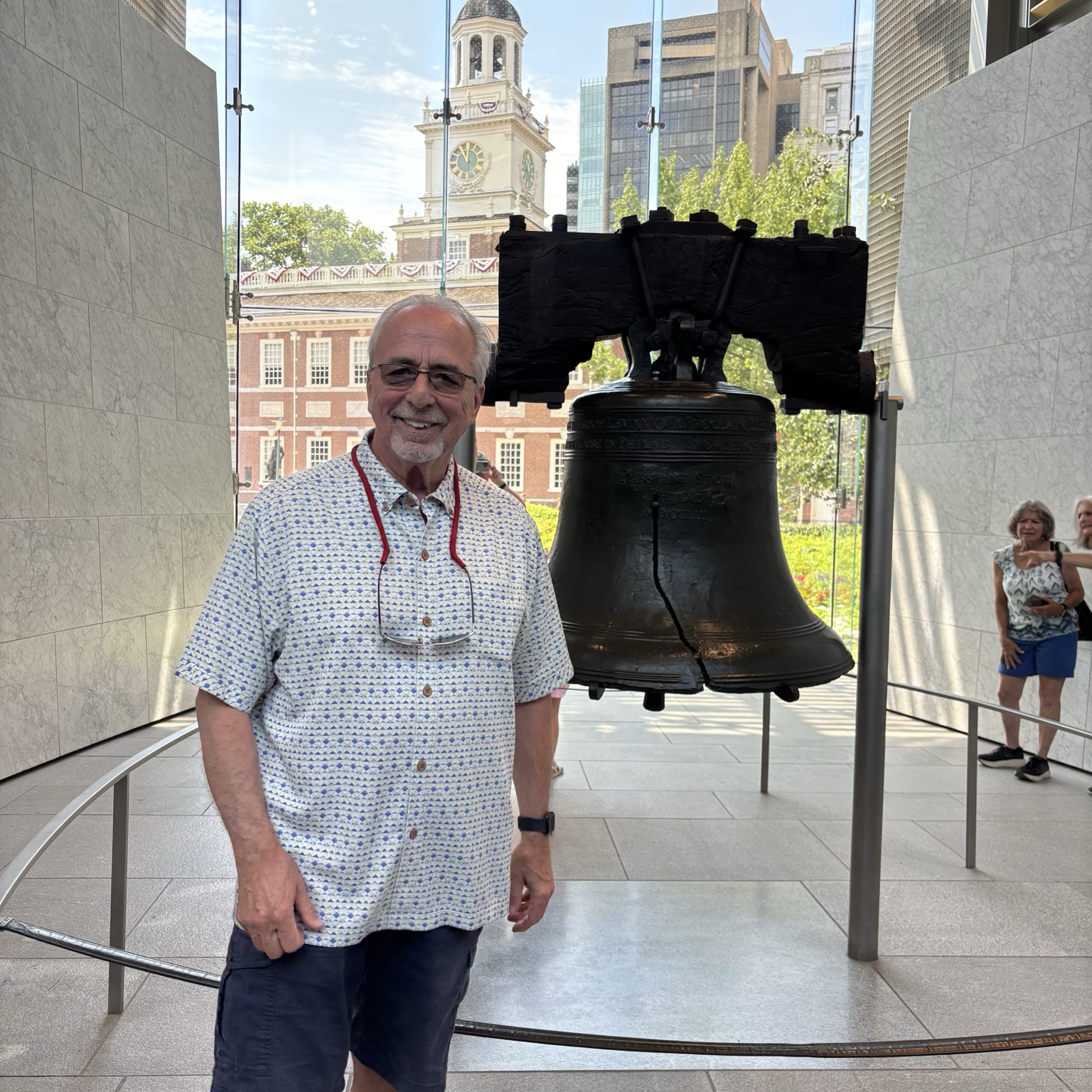
My wife, Cindy, and I had traveled to Philadelphia to spend a few days visiting my sister, Joan. What began as a family visit unexpectedly became something more. Together, we spent a full day exploring Independence Hall, the Liberty Bell, and the National Constitution Center. I did not arrive as a historian, scholar, or political expert. I came simply as a citizen curious to reconnect with the roots of the American story.
Philadelphia greeted us with a little of everything over three days—sunshine, clouds, rain showers, and changing skies. At times it felt as if the weather itself could not decide what story it wanted to tell. Perhaps that was fitting. The American story has never been all sunshine, and it has never been all storm. It has always moved through both.
What struck me most was not simply the grandeur of the buildings or the significance of the artifacts. It was the realization that many of the founders were ordinary citizens who chose to do extraordinary things. Some were young. Some are remembered by history while many others are not. They disagreed with one another, argued passionately, and faced uncertainty every day. There was no American playbook. They were writing it.
One realization stayed with me throughout the trip. The founders were not born as historical figures. They became historical figures because the nation they helped create endured. None of them knew whether the American experiment would survive, let alone that their names would be remembered 250 years later. They simply accepted the responsibility of their own moment in history.
Three Small Books…Three Big Lessons
Late that afternoon, while visiting the National Constitution Center bookstore, three small books caught my attention: Common Sense by Thomas Paine, George Washington’s Rules of Civility and Decent Behaviour, and The Promise of America. Interestingly, I hadn’t gone looking for books. In many ways, it felt as though these books found me.
Together they offered three simple lessons that remain just as relevant today as they were 250 years ago.
Common Sense reminded me to think independently. Paine wrote with plain arguments, simple facts, and common sense. He challenged citizens to set aside prejudice, use reason, and look beyond the present day.
Rules of Civility reminded me that self-government begins with self-discipline. Some of Washington’s rules sound amusing today, but beneath them lies a timeless principle: treat others with respect.
The Promise of America reminded me that the American experiment is not self-sustaining. Liberty, equality, consent of the governed, separation of powers, compromise, and the common good are not museum pieces. They are living responsibilities entrusted to every generation.
A World Cup in the Birthplace of America
Then there was the World Cup.
While walking through Philadelphia, we found ourselves surrounded by soccer fans from around the world gathering for a match between France and Iraq. Heavy rain delayed the game for nearly two hours. Rather than joining the crowds, Cindy, Joan, and I watched the match later that evening from Joan’s downtown Philadelphia apartment.
But the image stayed with me.
Two hundred and fifty years ago, delegates gathered in Independence Hall to debate the future of a new nation. On the day I visited, those same streets were filled with people from every corner of the world sharing a different kind of gathering.
The founders could never have imagined a World Cup in Philadelphia. Yet I suspect they would have recognized something familiar: people coming together in a public place, sharing a common experience, and participating in something larger than themselves.
Philadelphia did not simply witness history.
Philadelphia made history.
The American Experiment Continues
Faith, virtue, personal responsibility, reason, debate, and civic duty all played a role in the founding era. The founders were not perfect, and the country they created was not perfect. But they launched an experiment that allowed future generations to continue working toward a more perfect union.
Philadelphia is often called the birthplace of America. After spending time there, I came to see it as something more. It is a reminder that democracy is never finished. Every generation inherits the American experiment and is asked the same question:
What will you do with it?
Perhaps that is the enduring question as America celebrates its 250th birthday. The founders hoped they were creating something that would last. Two hundred and fifty years later, we have the privilege—and the responsibility—to help ensure that it does.
Sometimes we travel expecting to visit a place. Every so often, that place leaves us with something far greater than memories.
Philadelphia did that for me.
It reminded me that ordinary citizens can shape history, that great ideas often begin in simple conversations, and that every generation inherits the responsibility to carry the American experiment forward.
Happy 250th Birthday, America.
—John M. Obzud